
Guide · January 2026
Concrete Driveway Drainage Perth
Why driveways puddle and crack, how the falls and joints should be set out, and what to ask before the pour.
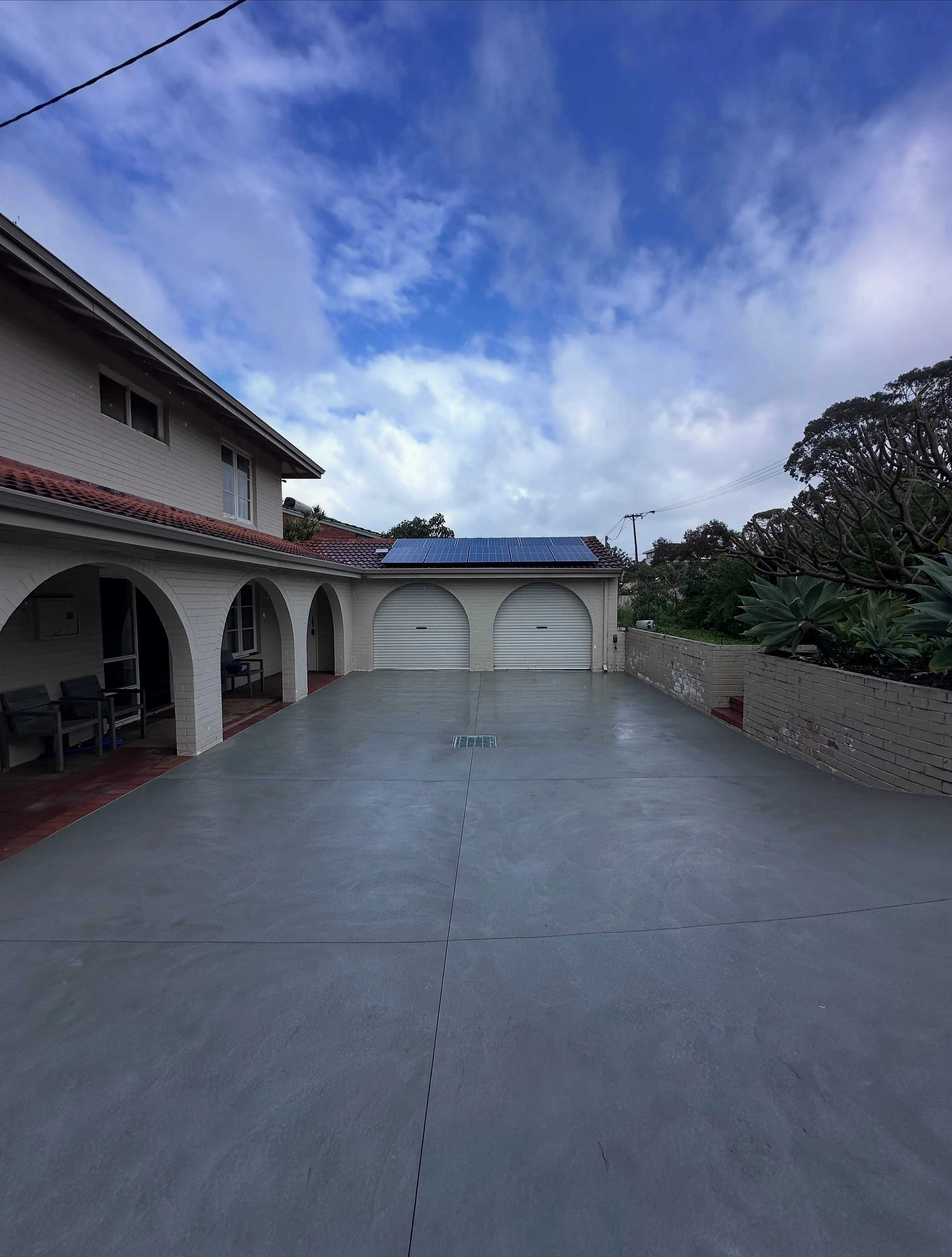
Concrete Driveway Drainage: Preventing Puddles & Cracks in WA Homes (2026 Guide)
A concrete driveway needs a fall of 1:60 to 1:80 away from the house, running consistently toward the street or a drainage point with no low spots. Get that wrong and water pools, and pooling is what causes the cracking, staining and early failure this guide is about. The slope has to be subtle enough to drive on and still steep enough to shed water.
Even a well-finished driveway deteriorates quickly if water isn’t directed away correctly.
In Perth and across WA, factors like heavy winter rain, sandy soils, clay movement and sloping blocks make proper driveway drainage essential. At Woodlands Construct, we design concrete driveways in Perth with drainage in mind from the very beginning, ensuring water flows where it should, not where it causes damage.
This 2026 guide explains how driveway drainage works, why it matters, and how to prevent puddles and cracking in WA homes.
- Why Driveway Drainage Matters in WA
- Common Drainage Problems in Perth Driveways
- Correct Falls & Slopes for Concrete Driveways
- Drainage Solutions for WA Homes
- How Poor Drainage Causes Cracks
- Common Drainage Mistakes to Avoid
- Related Services
- Final Advice for Homeowners
1. Why Driveway Drainage Matters in WA
Driveway drainage isn’t just about surface water, it directly affects the structural integrity of your concrete.
In WA conditions, poor drainage can lead to:
- Water pooling on the surface
- Erosion of the base beneath the slab
- Increased cracking from soil movement
- Staining and surface damage
- Reduced lifespan of the driveway
With Perth experiencing intense winter downpours followed by long dry periods, concrete must be designed to handle both excess water and soil movement.
2. Common Drainage Problems in Perth Driveways
Many drainage issues stem from poor planning rather than poor materials.
Common issues include:
- Flat or incorrectly sloped driveways
- Water draining toward garages or homes
- No allowance for runoff from roofs or hard surfaces
- Blocked or poorly placed strip drains
- Inadequate sub-base preparation
Even small puddles are a warning sign that drainage isn’t working correctly.
3. Correct Falls & Slopes for Concrete Driveways
Concrete driveways must be installed with the correct fall (slope) to move water away efficiently.
Typical driveway fall guidelines:
- 1:60 to 1:80 fall away from buildings
- Slope directed toward the street or drainage point
- Consistent fall across the slab (no low spots)
The slope must be subtle enough for safe vehicle access but effective enough to prevent pooling.
4. Drainage Solutions for WA Homes
Different properties require different drainage solutions.
Common driveway drainage options include:
Surface Falls
The most important element, directing water away naturally using slope.
Strip Drains (Channel Drains)
Installed across the driveway near garages or boundaries to capture runoff.
Spoon Drains
A shallow, curved channel formed into the concrete for controlled water flow.
Subsurface Drainage
Used in areas with poor soil or heavy runoff to prevent water buildup beneath the slab.
Edge Drainage & Landscaping Integration
Ensuring water flows into garden beds or soak wells where appropriate.
5. How Poor Drainage Causes Cracks
Water is one of the biggest contributors to driveway cracking.
Drainage-related cracking occurs when:
- Water softens the sub-base
- Soil expands and contracts unevenly
- Freeze-thaw cycles (in colder areas) stress the slab
- Water penetrates unsealed concrete
Even a correct driveway thickness and correctly reinforced concrete can fail if drainage is ignored.
6. Common Drainage Mistakes to Avoid
❌ Designing a flat driveway
Concrete needs fall, flat slabs trap water.
❌ Ignoring roof and hardscape runoff
Water from roofs and paths must be considered.
❌ Relying only on drains
Drains support good design, they don’t replace it.
❌ Poor base preparation
Waterlogged bases lead to long-term movement.
❌ Skipping sealing
Sealing reduces moisture penetration and staining.
Have a question we have not answered?
Get in contact and we can give you an answer.
- Why does water pool on my concrete driveway? Pooling usually means the driveway has incorrect fall or low spots.
- Can drainage be fixed after installation? Minor issues can sometimes be corrected, but major problems often require rework.
- Do strip drains always need to be installed? Not always, correct slope often removes the need for drains.
- Does exposed aggregate affect drainage? No, The exposed aggregate finish choice doesn’t replace proper fall and drainage design.
- How often should drains be cleaned? At least once a year, especially before winter.
Pooling usually means the driveway has incorrect fall or low spots.
Minor issues can sometimes be corrected, but major problems often require rework.
Not always, correct slope often removes the need for drains.
No, The exposed aggregate \nfinish choice doesn’t replace proper fall and drainage design.
At least once a year, especially before winter.
7. Related Services
These services work closely with driveway drainage design:
- Concrete Driveways Perth
- Grey Concrete Driveways Perth
- Exposed Aggregate Driveways Perth
- Concrete Sealing Perth
- Architectural Concrete Perth
Correct drainage is considered in every driveway we install.
8. Final Advice for Homeowners
Concrete driveway drainage is not something to “hope works out”. It must be designed properly from day one to protect your investment.
At Woodlands Construct, we assess slope, runoff, soil and surrounding surfaces to deliver driveways that stay dry, crack-free and functional in WA conditions.
Contact us today for expert advice and a free driveway assessment.
More guides
- January 2026 Concrete Sealing Perth What sealing actually does, how long it lasts on each finish, and how to tell when a surface is due for another coat.
- January 2026 How Thick Should a Driveway Be? WA Guide 2026 How thick a driveway needs to be in WA, what the standards actually say, and why soil and vehicle weight change it.
- January 2026 Concrete Alfresco Flooring Perth Finishes that suit an open plan alfresco, what each costs to run out, and which ones date faster than others.
- February 2026 Concrete Patio & Alfresco Colours How colour and finish change the way a patio feels underfoot and how it ages. What to weigh up before you commit.
Want a number for your own job?
Rough size, what is there now, and roughly when. Regan will tell you straight what it involves.